Quick answer: Sometimes. If you report an investment fraud to the Cyber Crime Helpline 1930 within the first hour, police and banks can try to freeze the money before it moves on. Releasing frozen money usually needs a court order. After the money has been withdrawn or passed through several accounts, recovery is much harder, and no one can guarantee a refund.
Key takeaways
- Call 1930 first, then your bank, then file on cybercrime.gov.in.
- Calling 1930 starts a freeze request. It does not reverse the payment or guarantee a refund.
- Never pay “tax” or “fees” to release your own money. That is a second-stage scam.
- Check any broker or adviser on SEBI’s intermediary search before investing.
- Report anyway if days have passed. The complaint is still needed for the investigation.
Why is investment fraud such a big problem in Telangana?
Investment and trading fraud is the largest source of cybercrime losses in Telangana. Investment frauds account for around 60% of cybercrime losses in the state. Telangana also had 44% of all cybercrime FIRs registered in India in 2025. Residents of Hyderabad are a common target.
How do stock trading and investment scams work?
Most scams follow the same five stages:
Approach: A stranger invites you to a WhatsApp or Telegram group, often called a “VIP” or “institutional trading” group. SEBI has warned that fraudsters use labels like “VIP Groups” or “Free Trading Courses”, and some impersonate SEBI-registered intermediaries or public figures.
Trust-building: Fake testimonials, profit screenshots and “experts”. Fraudsters copy the names, logos and registration numbers of genuine intermediaries on fake websites, apps and social media profiles.
The app: You are told to download a trading app that is not linked to a recognised broker, and to transfer money directly.
Early “profits”: The app shows large gains, and a small withdrawal may be allowed to build confidence.
The trap: You are pushed to deposit more. When you try to withdraw, you are asked to pay “tax”, “fees” or “margin” first, and then contact stops.
What are the warning signs of a fake investment platform?
| Genuine, SEBI-registered | Warning sign of a scam |
|---|---|
| Registration number you can confirm on SEBI’s website | Registration number or “SEBI certificate” that cannot be verified |
| No promise of assured returns | Guaranteed or “risk-free” returns |
| Trading through the broker’s official app | App from an unsolicited link, or a developer name that doesn’t match the broker |
| Official business numbers | A generic mobile number |
| Payments to the broker or clearing corporation | Payments to personal or unrelated accounts |
| No fee needed to withdraw your own money | “Tax” or “fees” demanded before withdrawal |
SEBI does not authorise anyone to promise assured returns. Registered entities use official numbers in the “1600” series, so a generic mobile number is a red flag.
What should you do in the first hour after an investment fraud?
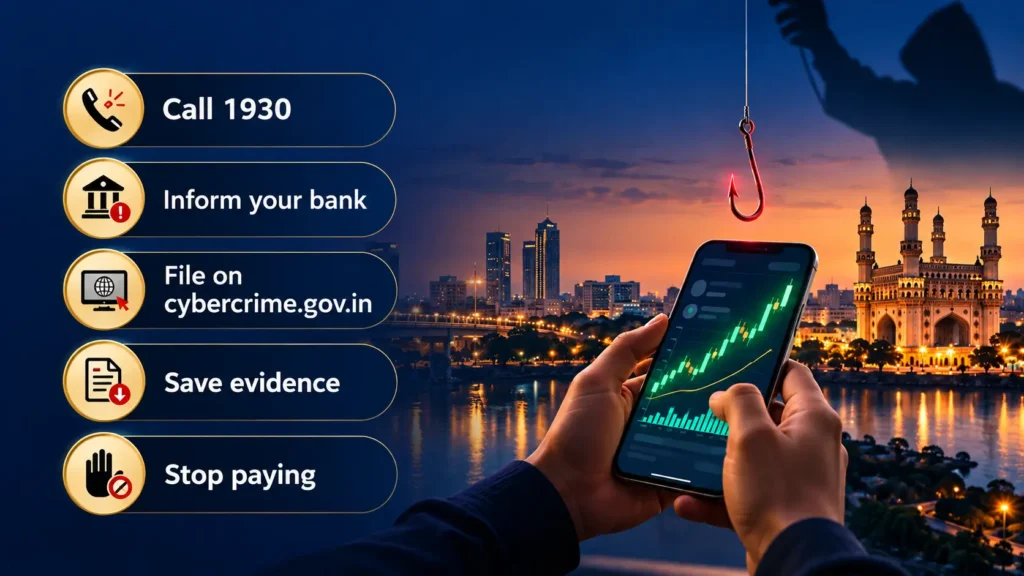
The sequence to remember is: 1930, bank, cybercrime.gov.in, evidence.
| Step | Action | Why |
| 1 | Call 1930 (National Cyber Crime Helpline) with the amount, time, your account and the receiver’s details | Starts the freeze request with the receiving bank |
| 2 | Call your bank and ask them to flag the transaction and the receiving account | Banks can act on their side, and you get a reference number |
| 3 | File on cybercrime.gov.in and note the acknowledgement number | Creates the formal record |
| 4 | Save chats, group names, phone numbers, screenshots, UPI IDs, bank details, receipts | This is your evidence, so don’t delete the app or group |
| 5 | Stop paying anything more | Further payments are the scam’s second stage |
How does the 1930 freeze and money recovery process work?
Complaints made to 1930 go into the Citizen Financial Cyber Fraud Reporting and Management System (CFCFRMS), which connects police, banks and payment providers. If the money is still in the receiving account, the bank may place a hold on it. That is why the first hour matters.
Be realistic about what it can do:
- Calling 1930 does not automatically reverse a UPI transfer, register an FIR, or guarantee that your money will return.
- A freeze only works on money that is still in the account. Fraudsters often split funds across several “mule” accounts.
- Frozen money is not returned automatically. Release usually needs a court order following the police investigation.
What legal action can you take after an investment fraud?
| Route | Relevant law or forum | Purpose |
|---|---|---|
| Criminal complaint | BNS Section 318 (cheating), Section 319 (cheating by personation); IT Act Sections 66C and 66D | Police investigation and prosecution |
| Organised group | BNS Section 111 (organised crime, which includes cyber crimes) | Heavier penalties where a syndicate is involved |
| SEBI complaint | SCORES portal (scores.gov.in) | Where a SEBI-registered entity is involved or being impersonated |
| Court application | Magistrate’s court | Release of frozen funds |
| Civil recovery | Civil suit | Recovery and damages where the persons can be identified |
SEBI advises complainants to attach evidence such as screenshots, phone numbers and money-transfer details.
Does the bank have to refund you? Banks are generally not liable when you authorised the payment yourself, even if you were tricked. Liability is more likely to come up where the transaction was unauthorised or the bank was slow to act after you reported it.
How can you verify a broker, adviser or trading app before investing?
- Check registration: Use the “Intermediary Search” tool on SEBI’s website to confirm the licence status.
- Use official apps only, from SEBI-registered brokers, and compare the developer name with the broker’s official website.
- Avoid unsolicited groups, and set your WhatsApp privacy so strangers can’t add you.
- Never transfer money to personal accounts for “investment”.
When should you speak to a cyber crime advocate in Hyderabad?
An advocate can help you file a properly evidenced complaint, follow up with the investigating officer and banks, apply to court for release of frozen funds, send legal notices, and advise if your own account received fraud money.
For the reporting steps in Hyderabad, see our guide on [how to file a cyber crime complaint in Hyderabad], and for our services, see [cyber crime legal services in Hyderabad].
Frequently asked questions
Sometimes. If you report quickly and the money is still in the receiving account, it may be frozen. Release usually requires a court order. If it has been moved on, recovery is uncertain.
It is the first hour after the fraud, when reporting to 1930 gives the best chance of stopping the money from moving on.
No. Report it anyway. Chances of freezing money are lower, but the complaint supports the investigation and can protect other victims.
Search for them on SEBI’s intermediary search, confirm the registration number, and compare the app and website with the details listed.
Call 1930 and file on cybercrime.gov.in. If a SEBI-registered entity is involved or being impersonated, also complain on SEBI’s SCORES portal.
Generally not, because the payment was authorised by you. Each case depends on its facts, so get advice early.
Sources and further reading
- National Cyber Crime Reporting Portal: cybercrime.gov.in
- SEBI intermediary search: sebi.gov.in/intermediaries.html
- SEBI complaints (SCORES): scores.gov.in
- SEBI investor advisories on social media and fake app frauds
Disclaimer: This article is general information, not legal advice. Please consult an advocate about your specific situation.
Last updated: 7 October 2026.