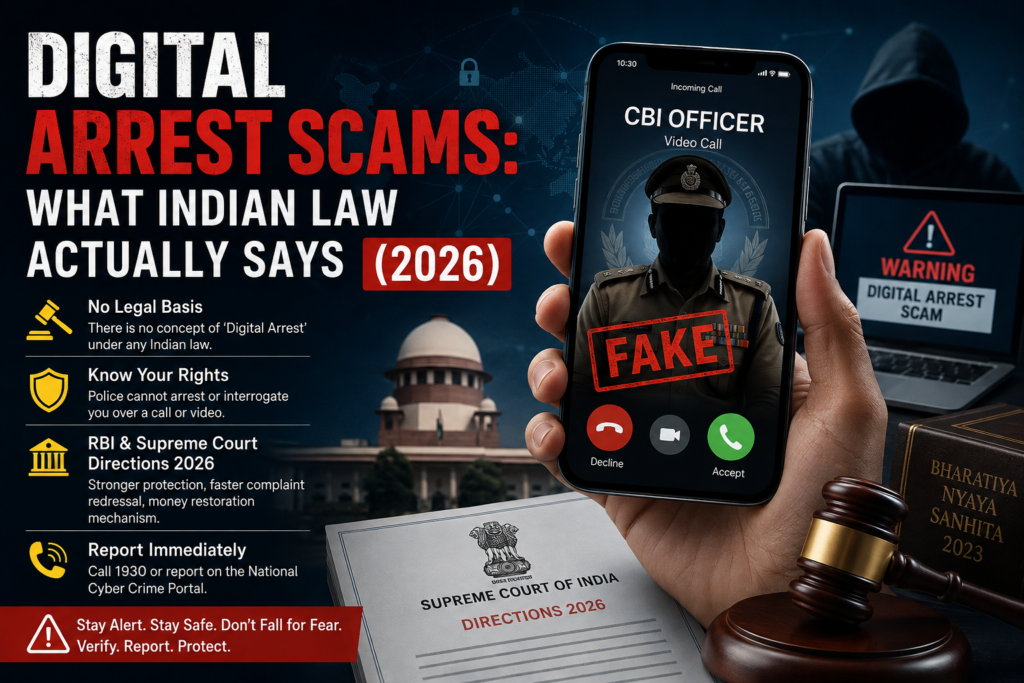
Digital Arrest Scams: What Indian Law Actually Says (2026)
Imagine receiving a video call from someone wearing a police uniform who says you’re involved in a money laundering case. They display what appears to be a Supreme Court warrant, demand that you stay on camera, threaten immediate arrest, and instruct you to transfer your money to a “safe government account.”
It sounds terrifying—but it’s a scam.
Digital arrest scams have become one of India’s fastest-growing cyber frauds, targeting professionals, students, business owners, NRIs, and especially senior citizens. Fraudsters impersonate agencies like the CBI, ED, Mumbai Police, RBI, TRAI, Customs, and Narcotics Bureau to psychologically manipulate victims into transferring large sums of money.
The most important legal fact for 2026 is simple:
There is no concept of “digital arrest” under Indian law.
The Government of India, Indian Cyber Crime Coordination Centre (I4C), and the Supreme Court have all clarified that no police officer or central agency can arrest, interrogate, or detain you over a WhatsApp, Skype, or Zoom video call.
This guide explains what digital arrest scams are, what Indian law actually says in 2026, your legal rights, and exactly what to do if you become a victim.
What Is a Digital Arrest Scam?
A digital arrest scam is a form of cyber-enabled extortion where criminals pretend to be government officials and falsely claim you’ve committed a serious crime.
Common allegations include:
- A parcel sent in your name contains drugs or fake passports.
- Your Aadhaar or PAN has been used for money laundering.
- Your SIM card is linked to criminal activities.
- Your bank account is connected to terrorism or illegal transactions.
- A court has issued a warrant against you.
The scammers then isolate victims by keeping them on continuous video calls for hours—or even days—while forcing them to transfer money.
How the Scam Typically Works
Step 1: Fake Call from a Government Agency
They spoof official phone numbers and claim to be from CBI, ED, RBI, Customs, or Police.
Step 2: Video Call “Interrogation”
Victims are instructed to keep their camera on and are warned not to disconnect.
Step 3: Fake Legal Documents
Fraudsters show forged FIRs, arrest warrants, RBI notices, or Supreme Court orders.
Step 4: Psychological Pressure
They threaten arrest, passport cancellation, bank account freezing, or media exposure.
Step 5: Money Transfer
Victims are told to send money to a “verification” or “safe custody” account.
According to I4C, these scams are often operated by organized cross-border cybercrime syndicates.
Is Digital Arrest Legal in India?
No. Absolutely not.
The Ministry of Home Affairs officially states:
“There is no concept of Digital Arrest under any Indian law.”
The I4C advisory clearly says that law enforcement agencies never arrest people digitally and never demand money over phone or video calls.
What Indian Law Actually Allows
Indian law permits:
- Physical arrest under legal procedures.
- Notice for investigation.
- Court summons.
- Search warrants issued through lawful processes.
But it does not allow:
- Arrest through WhatsApp or Skype.
- Keeping someone on video call as “custody.”
- Demanding transfer of money to prove innocence.
- Asking victims to keep investigations secret.
If someone claims otherwise, they are committing fraud.
Which Laws Protect Victims of Digital Arrest Scams?
Digital arrest scams are prosecuted under multiple Indian laws.
| Law | How It Applies |
|---|---|
| Bharatiya Nyaya Sanhita (BNS), 2023 | Cheating, extortion, impersonation, forgery, criminal intimidation, organized crime. |
| Information Technology Act, 2000 | Cyber fraud, identity misuse, electronic communications used for fraud. |
| Telecommunications Laws | Misuse of telecom services, spoofed numbers, SIM fraud. |
| Banking & RBI Guidelines | Reporting unauthorized electronic transactions and freezing fraudulent transfers. |
Victims have the legal right to:
- File a cybercrime complaint.
- Request freezing of fraudulent transactions.
- Seek restoration of recovered money.
- Approach banking grievance mechanisms.
Supreme Court’s Big 2026 Directions on Digital Arrest Scams
In August 2026, the Supreme Court issued nationwide interim directions to strengthen India’s response to digital arrest scams. These are the biggest legal developments so far.
Key Supreme Court Directions
| Direction | Why It Matters |
|---|---|
| RBI must issue a Standard Operating Procedure (SOP). | Banks must temporarily hold suspicious transactions linked to cyber fraud. |
| States must operationalize Money Restoration Mechanism. | Victims can recover frozen funds faster. |
| Nationwide Grievance Redressal Module. | Citizens get a standardized complaint process. |
| Expansion of e-Zero FIR. | Victims can register cyber FIRs more quickly across states. |
| Examine a “Kill Switch” for suspicious calls. | Authorities are evaluating emergency interruption mechanisms for scam calls. |
| Victim compensation framework under consideration. | Future policy may include shared liability for certain cyber fraud cases. |
The Court also directed banks, telecom operators, intermediaries, and governments to improve coordination against cyber fraud.
RBI’s Latest Rules and Banking Protection (2026)
The Reserve Bank of India has been instructed to implement stronger safeguards against cyber fraud.
What Banks Are Expected to Do
Temporarily freeze suspicious “mule” accounts.
Delay suspicious credits where necessary.
Improve customer protection for unauthorized electronic transactions.
Participate in centralized money restoration mechanisms.
What This Means for Victims
If you report quickly:
- Fraudulent transfers may be frozen.
- Money may be recovered before withdrawal.
- Banks coordinate with I4C and cyber police.
Time matters the most.
What Should You Do in the First 30 Minutes?
- Disconnect the Call Immediately
Do not continue the conversation.
- Never Transfer Money
Government agencies never ask for “verification deposits.”
- Call 1930 Immediately
India’s National Cyber Fraud Helpline works for urgent financial fraud reporting.
- Report at the National Cyber Crime Portal
File your complaint on the Government of India’s cybercrime reporting portal.
- Inform Your Bank Immediately
Request freezing or reversal of suspicious transactions.
- Preserve Evidence
Save screenshots, call recordings, WhatsApp chats, UPI IDs, account numbers, and transaction IDs.
The sooner authorities receive the complaint, the greater the chance of freezing the funds.
Can You Recover Your Money?
Yes—but recovery depends heavily on speed.
Recovery Process in India (2026)
- Report within minutes or hours
Call 1930 immediately after discovering the fraud.
- Cyber Police alert banks
Banks attempt to freeze destination accounts before funds move.
- Money Restoration Mechanism
Eligible recovered funds can be restored to victims through the centralized system.
- Grievance Redressal Module
Victims can track complaints and restoration progress through participating banks.
The Supreme Court noted that tens of thousands of cases have already been processed through restoration mechanisms involving participating banks and states.
How Cyber Lawyers Can Help Victims
If you’ve lost money in a digital arrest scam, legal assistance can help with:
- Filing cybercrime complaints.
- Drafting legal notices to banks.
- Following up with cyber police.
- Seeking recovery of frozen funds.
- Banking ombudsman complaints.
- Consumer disputes where applicable.
- Court proceedings in complex fraud cases.
For high-value frauds, early legal intervention can improve coordination between banks and investigating agencies.
Also Read: Role of Cyber Lawyers in Safeguarding Online Transactions
Final Thoughts
Digital arrest scams succeed because they exploit fear, urgency, and trust in authority. But Indian law is clear: no police officer, CBI official, ED officer, RBI representative, or court can digitally arrest you over a video call.
In 2026, the Supreme Court has strengthened protections through new RBI directions, faster money restoration mechanisms, grievance redressal systems, and nationwide coordination against organized cyber fraud. Citizens who report incidents quickly through 1930 and the National Cyber Crime Reporting Portal have significantly better chances of preventing further financial loss and recovering funds.
The safest response is simple:
Hang up. Verify independently. Report immediately. Never transfer money out of fear.
References & Sources (2026)
| Source | What it Supports in the Blog |
|---|---|
| Supreme Court of India – In Re: Victims of Digital Arrest Related Scams vs Dr. Mahendra Limaye (Order dated 4 August 2026) | Latest 2026 legal directions, RBI SOP, Money Restoration Mechanism, e-Zero FIR, grievance redressal framework, victim compensation discussion. |
| Indian Cyber Crime Coordination Centre (I4C) – Advisory on ‘Digital Arrest’ (6 March 2025) | Official definition of digital arrest scam, scam modus operandi, warning that “Digital Arrest” has no legal basis in India, precautions for citizens. |
| Ministry of Home Affairs / Press Information Bureau – Alert Against Digital Arrest Scams (14 May 2024) | Government advisory explaining impersonation scams involving CBI, ED, RBI, Customs, Police and instructions to report fraud through 1930 and Cyber Crime Portal. |
| Press Information Bureau – Cases of Digital Arrest Scams (27 November 2024) | Government initiatives through I4C, fake ID blocking, Joint Cyber Coordination Teams, National Cyber Crime Reporting Portal. |
| Ministry of Home Affairs – Lok Sabha Reply on Digital Arrest Scam (10 December 2024) | 1930 Helpline, Citizen Financial Cyber Fraud Reporting & Management System (CFCFRMS), awareness campaigns, blocked Skype IDs, WhatsApp accounts, spoofed call prevention. |
| National Cyber Crime Reporting Portal (cybercrime.gov.in) | Official reporting mechanism, advisories, suspect search feature, citizen reporting process. |
Frequently Asked Questions
No. The Government of India and I4C have officially stated that there is no concept of digital arrest under Indian law.
No. Police cannot legally arrest or detain anyone over WhatsApp, Skype, Zoom, or similar platforms.
No. No government agency asks citizens to transfer money into “safe” or “verification” accounts.
Call 1930 immediately and file a complaint on the National Cyber Crime Reporting Portal.
Yes. If reported quickly, banks and cyber authorities may freeze fraudulent transactions and restore eligible funds through official mechanisms.