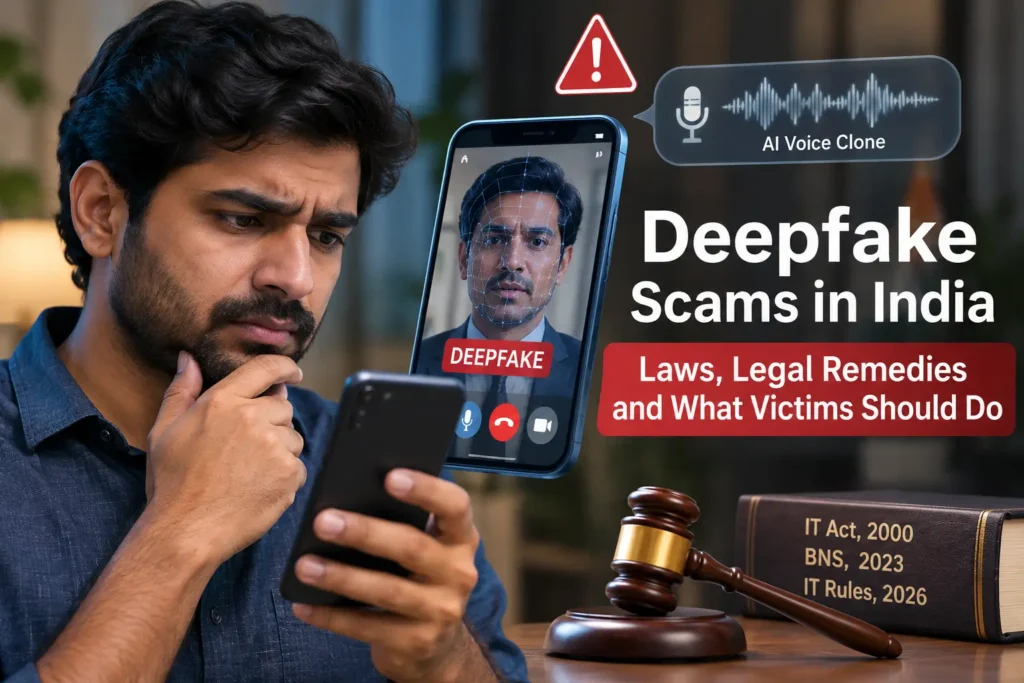
A familiar voice on the phone asks for urgent money. A video appears to show someone making a statement they never made. A fake image circulates online and damages a person’s reputation. These situations may involve deepfakes or other forms of AI-generated impersonation.
Artificial intelligence has made it easier to create realistic images, videos and voice recordings. While these tools have legitimate uses, they can also be misused to impersonate people, deceive families, demand money, spread false information or create intimate images without consent.
For an ordinary person, the difficult part is not always recognising a deepfake. It is knowing what to do after discovering one.
If someone has used your face, voice or identity to deceive others, you may have legal options under Indian law. The steps you take immediately—preserving evidence, reporting the content and informing the appropriate authorities—can make a difference.
This guide explains what deepfake scams are, how Indian law addresses them, and what victims can do.
What is a deepfake?
A deepfake is digitally created or altered audio, video or imagery that makes it appear as though a real person said or did something they never actually said or did.
For example:
- An AI-generated video may show a person appearing to make a false statement.
- A cloned voice may sound like a family member asking for emergency money.
- A manipulated photograph may be used to create a false or humiliating image.
- A fake video call may be used to impersonate a colleague, business owner or public official.
Deepfakes are one form of what Indian law now describes as synthetically generated information (SGI), where realistic artificial or algorithmic content may be perceived as genuine.
The important distinction is that not every AI-edited photograph or video is a harmful deepfake. Routine editing, such as improving image quality or reducing background noise without misrepresenting the original content, is different from creating deceptive material that impersonates a real person.
How do deepfake and AI voice-cloning scams happen?
Deepfake scams often rely on something more powerful than technology: trust.
A scammer may use publicly available photographs, videos or voice recordings to imitate someone. The victim may then receive a call, video, voice note or social media message that appears to come from a familiar person.
Some common examples include:
1. AI voice-cloning emergency scams
A person receives a call that sounds like their son, daughter, spouse or another relative. The caller claims to be in trouble and asks for money immediately.
The voice may sound convincing, but the person on the other end may be a fraudster using AI-generated audio.
2. Fake video-call impersonation
A scammer may use manipulated video or a synthetic face to appear like a known person during a video call. The purpose may be to obtain money, confidential information or access to an account.
3. Fake executive or business-payment instructions
An employee receives an audio message or video call that appears to come from a senior manager or business owner. The supposed superior instructs the employee to transfer money urgently or share sensitive information.
4. Fake images and videos used for blackmail
A person’s photograph may be manipulated to create an intimate or embarrassing image or video. The offender may threaten to circulate it unless the victim pays money or follows instructions.
Deepfake impersonation can also overlap with account hacking. For example, a fraudster may gain access to someone’s WhatsApp or Instagram account and use the trusted profile to contact friends, relatives or customers. If you suspect that an account has been compromised, read our guide on legal steps to take when WhatsApp or Instagram is hacked. It explains practical account-recovery and reporting steps that may be relevant alongside a deepfake complaint.
5. Fake endorsements and investment promotions
A deepfake may make it appear that a well-known person is recommending an investment, trading platform or financial product. Victims may be persuaded to transfer money to fraudulent accounts.
A convincing video is not proof that the person actually made the statement. Always verify an unexpected request through a separate, trusted communication channel.
A fake celebrity endorsement or an apparently genuine investment video can persuade people to transfer money to fraudulent platforms. If you have already invested or transferred funds after relying on such a promotion, the next steps may involve reporting the transaction, contacting your bank and preserving the payment evidence. Our article, Investment Fraud: Can You Get Your Money Back?, discusses the options victims may consider after an online investment scam.
What should you do if someone uses your face or voice in a deepfake?
If you discover a deepfake involving you or someone you know, try to act promptly. Do not panic, and do not delete the original messages or files.
Step 1: Preserve the evidence
Save the available evidence before reporting or requesting removal.
Depending on the incident, this may include:
- Screenshots showing the post, message, account name and date.
- The original URL or link to the content.
- The profile or account that uploaded or shared it.
- Original messages, emails, voice notes or call details.
- Payment receipts, UPI IDs, bank details or transaction references, if money was lost.
- Any threats, demands or communications from the person responsible.
Keep the original files where possible. Avoid editing, cropping or repeatedly forwarding the evidence, as this may affect its usefulness during an investigation.
If the content is intimate or involves a child, do not circulate or download it unnecessarily. Preserve the available identifying details and seek guidance from the police or appropriate authorities.
Step 2: Report the content to the platform
Report the post, account, video or message through the platform’s complaint mechanism.
Explain clearly that the content is manipulated, impersonates an identifiable person, violates privacy, or is being used for fraud or harassment, as applicable.
Include the direct URL and relevant screenshots. Keep a copy of the complaint and any acknowledgement or reference number.
If the platform has a Grievance Officer, use the published grievance process. If the complaint is not properly addressed, the applicable appeal mechanism may also be available.
Step 3: File a cybercrime complaint
If you are unsure how to approach the complaint process, it may help to understand the steps involved before submitting your report. Our guide on how to file a cybercrime complaint in Hyderabad explains how victims can report online offences, approach the appropriate authorities and prepare the information needed for a complaint. Although the guide focuses on Hyderabad, the general reporting principles may also help people understand the process elsewhere in India.
Step 4: Seek legal advice where necessary
Consider speaking to a lawyer if the incident involves financial loss, blackmail, threats, repeated harassment, non-consensual intimate imagery, serious reputational damage or a failure to address a platform complaint.
The appropriate legal response depends on the content, the intention behind its creation or circulation, the harm caused and the available evidence.
What changed under India’s 2026 IT Rules amendments?
An important development is the Information Technology (Intermediary Guidelines and Digital Media Ethics Code) Amendment Rules, 2026, which came into force on 20 February 2026.
The amendments specifically address synthetically generated information, including realistic AI-generated or AI-altered audio, images and videos.
In practical terms, the amended framework strengthens obligations on covered intermediaries and platforms. These include:
- Taking reasonable technical measures to prevent unlawful synthetic content.
- Addressing content involving impersonation, non-consensual intimate imagery and other prohibited material.
- Applying labelling and provenance or identifier requirements to permissible synthetic content.
- Providing user warnings about the consequences of unlawful content.
- Following revised timelines for certain complaints and removal requests.
There are important distinctions between the timelines:
- For specified complaints involving nudity, sexual content, morphed content or impersonation under the relevant rule, the platform is required to remove or disable access within two hours of receiving the complaint.
- For certain other grievances involving requests for removal or disabling access, the amended framework provides a 36-hour timeline.
- Where the intermediary receives actual knowledge through a qualifying court order or reasoned intimation from an authorised government officer, the relevant removal or disabling timeline is three hours.
These are specific legal timelines under the Rules; they should not be treated as a guarantee that every informal report to a platform will result in removal within the same period.
The amendments are significant because they expressly address realistic synthetic content and strengthen the framework for platform accountability. They do not mean that every AI-generated image or video is unlawful. Context, consent, deception and the applicable law still matter.
Can a victim get a deepfake removed?
A victim can report unlawful deepfake content to the platform and request removal or disabling of access. The complaint should identify the exact content and explain the nature of the harm.
A useful complaint should include:
- The direct URL of the content.
- The account name or profile responsible for posting it, if known.
- A brief explanation of how the content impersonates or harms the person.
- Screenshots or other supporting evidence.
- A request to remove or disable access to the content.
- A request to preserve relevant records for lawful investigation, where appropriate.
If the platform does not address the complaint, consider escalating it through the platform’s Grievance Officer and the applicable grievance appeal mechanism.
Where the content involves threats, blackmail, sexual exploitation or financial fraud, a platform report should not replace a police or cybercrime complaint.
What if a deepfake scam has already caused financial loss?
If you transferred money after receiving an AI-generated voice message, fake video call or impersonation request, act quickly.
- Call 1930 and report the financial cyber fraud.
- Inform your bank or payment service provider immediately and request that the transaction be reported and appropriate protective steps be taken.
- Preserve the UPI ID, bank account details, transaction reference, messages and call information.
- File a complaint through https://cybercrime.gov.in/.
- Keep the complaint acknowledgement and bank communication records.
Quick reporting may help authorities and financial institutions take steps to trace or restrict the movement of funds. However, recovery is not guaranteed. The outcome depends on factors such as the time taken to report, the movement of funds and the investigation.
How can you protect yourself from AI voice-cloning scams?
You do not need advanced technical knowledge to reduce the risk. A few everyday precautions can help.
Verify urgent money requests. If a familiar voice asks for money, call the person back using a number you already know.
Create a family verification method. Families can agree on a simple question or verification phrase for emergencies. Do not share it publicly.
Be careful about sharing personal recordings. Public videos and voice recordings can potentially be misused to imitate you.
Do not act under pressure. Scammers often insist that a payment must be made immediately or that the matter must remain secret. Pause and verify.
Check the source, not just the appearance. A video or voice note can look or sound convincing and still be manipulated. Confirm important announcements through official channels.
Secure your accounts. Use strong, unique passwords and multi-factor authentication. Never share OTPs, passwords or banking credentials with callers.
Warn others when impersonation is discovered. A timely warning to friends, family or colleagues may prevent additional victims.
Final thoughts
Deepfake technology can make impersonation more convincing, but a convincing voice or video should never replace verification. If someone uses your identity, face or voice to deceive, threaten or exploit you, do not assume that nothing can be done.
Preserve the evidence, report the content, contact the police where necessary and act quickly if money has been lost. The legal response will depend on the facts, but Indian law now contains provisions that can address several forms of digital impersonation and misuse of synthetic media.
At Cyber Advocate, our aim is to make cyber law easier to understand so that people can make informed decisions when facing online threats.
Author: Kodamagundla Ravi Kumar, Advocate
Cyber Advocate – Cyber Law Awareness and Legal Guidance
Disclaimer: This article is intended for general legal awareness in India and is not a substitute for advice on an individual case. The applicable legal provisions and remedies depend on the facts, evidence and current law. Consult a qualified lawyer for advice about your circumstances.
Frequently asked questions
Yes, where the facts establish an offence. AI voice cloning used to impersonate someone and cheat a victim may attract provisions such as Section 66D of the IT Act and Section 319 of the BNS, depending on the evidence and circumstances.
Preserve the URL, screenshots, account details and related messages. Report the content to the platform, file a cybercrime complaint and approach the police where appropriate. If the video is intimate, threatening or being used for blackmail, seek urgent assistance and avoid circulating it further.
Yes. The National Cyber Crime Reporting Portal provides routes for reporting different types of cybercrime, including online and social-media-related offences. Select the category that best fits the incident and provide the available evidence.
Potentially, yes. Depending on the facts, the conduct may raise criminal or other legal issues. Preserve the original content and evidence of its circulation and impact, and obtain legal advice about the appropriate remedy.